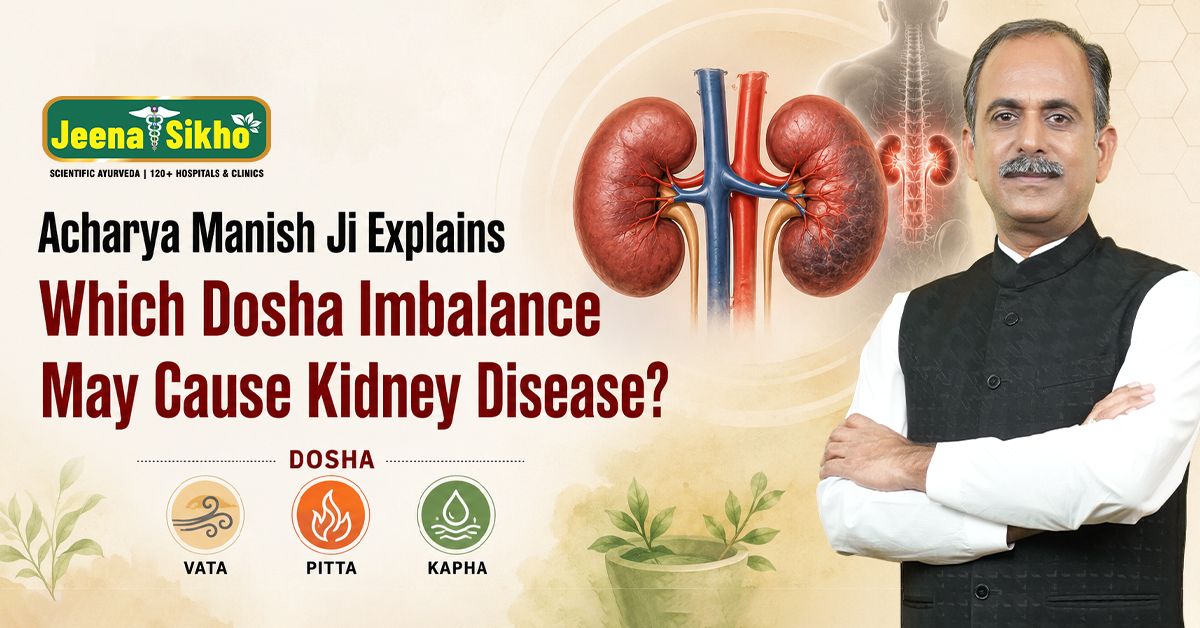

Swelling in the ankles. Foamy urine. A burning sensation that won’t quit. Different symptoms, different people, but Ayurveda traces most of it back to one thing: a dosha imbalance disturbing how the kidneys function.
Acharya Manish Ji often breaks this down simply for patients: your kidneys aren’t just filtering waste, they’re deeply tied to Vata, Pitta, and Kapha, and figuring out which one has gone off-balance changes everything about how kidney disease actually gets addressed. Here’s what that connection actually looks like, and why it matters more than most people realise.
What is Kidney Disease in Ayurveda, Really?
Ayurveda calls the kidneys Vrikka, formed from Rakta (blood tissue) and Meda (fat tissue) together. Not just a filter. A whole system tied to fluid balance, waste elimination, and something called Ojas, your body’s vital energy.
Kidney disease in Ayurveda isn’t seen as a random organ failure. It’s read as a sign that something upstream has gone wrong, usually starting with a disturbance of Apana Vata, the downward-moving energy responsible for elimination.
Vata Dosha and Kidney Health: The Main Driver
Most kidney trouble in Ayurveda traces back here first. Vata dosha and kidney health are closely linked through Apana Vata, specifically, the subtype responsible for pushing urine, stool, and waste out of the body. Disturb it, and things start drying out.
Tissue degradation. Reduced urine output. A general sense of depletion in the kidneys over time. Common causes? Holding in urine too often, not drinking enough water, or simply eating too much dry, rough, or cold food over the years.
Kapha Dosha and Kidney Disease: When Swelling Takes Over
Different picture entirely. Kapha dosha and kidney disease show up together when there’s excess heaviness in the system, think swelling, sluggish digestion, murky or cloudy urine, that dragged-down kind of fatigue.
Kledak Kapha, specifically, governs moisture in the digestive tract, and when it builds up excessively, kidney function slows right along with it. This is usually the pattern behind conditions involving fluid retention and blocked urinary channels.
Pitta Dosha and Kidney Function: The Burning Signs
Then there’s the third pattern. Pitta dosha and kidney function get disrupted when there’s excess heat in the system, and it’s usually the easiest to spot. Burning urination. Irritation.
Urine that looks darker or more yellow than usual. Inflammation tends to sit at the centre of this one, often triggered by spicy, acidic, or fried food eaten too often over time.
Acharya Manish Ji’s Expert Advice: How Do You Know Which Dosha is Involved?
Fair question, and honestly, it’s rarely just one dosha acting alone. Acharya Manish Ji’s take on this, often shared in his teachings, is that most chronic kidney conditions involve Vata as the dominant force, with Pitta or Kapha layered on top, depending on the person. Acharya Manish Ji expert advice on this usually comes down to observation first, watch your urine colour, your energy levels, whether you’re dealing with dryness or swelling, and that alone tells you a lot before any lab test does.
For anyone wanting to go a step further, Healing With Acharya Manish shares guided resources that walk you through understanding your Prakriti, your natural body constitution, and how it’s currently showing up as an imbalance, or Vikriti. It’s a genuinely useful starting point if you’ve never really thought about your dosha imbalance before.
That said, self-assessment only goes so far. A proper reading through pulse, physical examination, and a real conversation about your symptoms, done by a trained Ayurvedic doctor, catches things a quiz or checklist simply can’t.
Can Balancing Your Dosha Actually Support Kidney Healing Naturally?
To a real extent, yes, especially in earlier stages. Kidney healing naturally through Ayurveda usually starts with correcting whichever dosha has tipped out of balance: warming, grounding foods and enough hydration for Vata imbalance; lighter, less oily meals for Kapha; and cooling, less spicy food for Pitta-driven inflammation.
Herbs like Punarnava and Gokshura get added depending on which pattern is dominant. None of this replaces medical monitoring for anyone already dealing with diagnosed kidney disease, but as a supportive, root-level approach, it genuinely has a place alongside conventional care.
Conclusion
Understanding which dosha imbalance is actually driving your kidney concern changes the entire approach, from diet to herbs to daily habits. It’s not guesswork once you know what to look for.
If you want to explore more of Acharya Manish Ji’s teachings on dosha balance and natural healing, visit Healing With Acharya Manish for guided resources on understanding your Prakriti and current imbalance, or book a VOPD consultation with Jeena Sikho HiiMS to get a proper, doctor-led assessment of what’s actually going on with your kidneys.
FAQs
1. Can more than one dosha be involved in kidney disease at the same time?
Yes, most chronic kidney diseases are mainly Vata driven, with Pitta or Kapha frequently layered over.
2. How do I know if Kapha is causing the swelling related to my kidneys?
If there is swelling, look for heaviness, slow digestion and cloudy urine, which are usually signs of Kapha involvement.
3. Does burning urination always mean a Pitta imbalance?
Often, yes, but it’s worth getting it checked medically too, since infections can cause similar symptoms.
4. Can I take dosha correction instead of my current medication for kidney?
No, it’s not a substitute for medical treatment and regular monitoring, but it’s meant to complement it.
5. How do I find my dominant dosha for kidney problems?
Ideally, with a trained Ayurvedic doctor, through a detailed consultation of symptoms, urine characteristics, diet and lifestyle.
Disclaimer: The information provided on this blog is for general educational and informational purposes only. It is not intended to replace professional medical advice, diagnosis, or treatment. Always consult a qualified healthcare professional before making any changes to your diet, lifestyle, or treatment plan. Individual results may vary.